
The Illusion of Simplicity: Why Direct Integration Is a Trap
An event driven AI architecture often begins with a simple temptation: connect the AI directly to the ERP. The REST API already exists, the data is there, and the reasoning seems sound. If the chatbot needs to check stock, why not let it ask the ERP directly?
On a diagram, the connection looks clean. In production, it can become an architectural ticking time bomb.
An LLM is not a conventional interface that waits politely for one user to click one button at a time. It can trigger chains of requests, serve thousands of users, and turn a simple question into several calls to systems that were never designed for that rhythm.
The result is a dangerous combination: Tight Coupling and Compound Latency. The AI inherits every delay, lock, and failure of the ERP. At the same time, the ERP inherits the pressure generated by the AI.
Anatomy of Failure: The Problem with Synchronous APIs
When an integration relies entirely on request and response, the performance of the AI becomes chained to the performance of every system behind it.
Consider a simple question:
What is the status of my last five orders?
1. The user asks the question.
2. The AI interprets the intent.
3. The AI sends an HTTP request to the ERP.
4. The ERP receives the request, places it in a queue, and runs the necessary queries.
5. The ERP returns the result.
6. The AI interprets the data and generates the answer.
Nothing in this sequence looks unreasonable on its own. The problem is that every step must wait for the previous one.
The Latency Equation
The total response time includes the time required to interpret the request, travel across the network, query the ERP, return the data, and generate the final answer.
If the ERP takes four seconds to complete a complex query, no amount of prompt engineering can make those four seconds disappear. Once network time, queueing, orchestration, and model generation are added, the user may wait five to eight seconds for what appeared to be a simple question.
When the ERP Becomes a Single Point of Failure
Latency is only the first warning.
If the ERP enters maintenance, encounters a database lock, or reaches its connection limit, the AI assistant loses access to the information it needs. Its apparent intelligence is still tied to the availability of the central system.
The AI has no independent memory of the operation. It remains connected to the ERP by an umbilical cord. If the central system coughs, the AI catches a cold.
The Paradigm Shift: Stop Asking and Start Listening
To scale AI in a serious enterprise environment, the architecture has to change its posture.
Instead of sending the AI to knock on the ERP door every time a user asks a question, the system allows relevant changes to travel toward the AI before the question even exists.
Stop asking. Start listening.
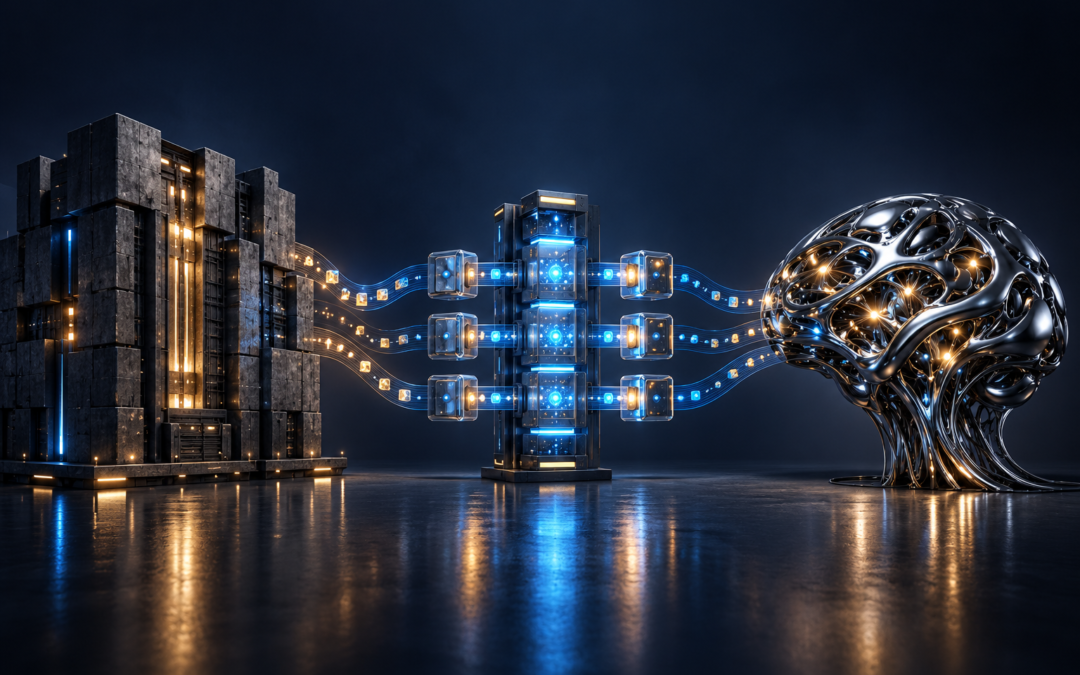
This is the role of event driven architecture. When an order is created, stock changes, or a customer record is updated, that change becomes an event. The event travels through the architecture and updates a source designed for fast retrieval.
When the user eventually asks a question, the AI no longer needs to interrupt the ERP. It can consult information that has already been prepared for it, while the ERP continues doing the transactional work it was built to do.
How Event Driven AI Architecture Works in Practice
1. The business system records a change. An order is created, a payment is confirmed, stock is updated, or a customer changes an address. The ERP or an integration layer publishes an event describing what happened.
2. The event travels through an intermediary such as Kafka, RabbitMQ, or EventBridge. The publisher does not need to wait while every interested system processes it.
3. A service connected to the AI receives the event, validates it, transforms it, and updates the appropriate knowledge store, search index, or vector database.
An event might contain information such as:
{“type”:”OrderUpdated”,”id”:1024,”status”:”Shipped”,”timestamp”:”10:00:00″}
The event is not the answer to a user question. It is a signal that allows the rest of the architecture to remain informed without repeatedly interrogating the ERP.
Three Concepts Behind the Pattern
- Synchronous and asynchronous communication: A synchronous exchange is like a phone call. Both parties must remain on the line until the conversation is finished. An asynchronous exchange is closer to sending a message. The sender can continue working while the receiver processes it when ready.
- Retrieval Augmented Generation: RAG allows an AI system to retrieve information from an external source before producing an answer. In this architecture, that source is updated through events, so the AI can access recent operational information without querying the ERP for every conversation.
- Change Data Capture: Some legacy systems were never designed to publish events. Change Data Capture can observe changes recorded in database logs and turn them into events without forcing the old application to behave like a modern platform.
The Three Strategic Victories of Decoupling
Decoupling does more than improve a technical diagram. It changes how the business experiences the system.
The AI becomes faster, the architecture becomes more resilient, and the ERP is allowed to protect the transactional work that keeps the company running.
1. Faster Answers Without Pressuring the ERP
When a user asks about an order, the AI can consult a knowledge store or search index designed for fast reading. It does not need to launch a complex query against the ERP during the conversation.
Events do not eliminate latency. They move most of it away from the moment when the user is waiting.
The work required to detect, transform, and index a change has already happened in the background. The result is a response that feels immediate without forcing the ERP to accelerate every time the AI receives a question.
2. Resilience When the Core System Is Unavailable
If the ERP becomes unavailable on a Tuesday afternoon, the AI does not necessarily have to disappear with it.
It can continue answering questions from the last successfully processed state, provided that the limits of that information are made clear. It cannot confirm a transaction that happened during the outage, but it can preserve access to knowledge that was already available.
This is temporal decoupling. The systems no longer need to be available at exactly the same moment in order to provide value.
3. Protection for the Transactional Core
A successful AI assistant can become one of the most demanding clients an ERP has ever faced.
If ten thousand employees begin asking questions at the same time, the last thing we want is ten thousand complex queries competing with invoicing, inventory, payments, and daily operations.
Without decoupling, success itself can create the outage.
An event driven architecture redirects that reading pressure toward systems designed to absorb it. The ERP remains responsible for transactions. The AI works from information prepared for consultation. Each system is allowed to do the job it was designed to do.
Invisible Engineering Is What Counts
The success of Generative AI in the enterprise does not begin with the model. It begins with the architecture surrounding it.
The model is the part everyone can see. The event flows, data contracts, queues, indexes, recovery mechanisms, and observability remain hidden. Yet these invisible elements determine whether an impressive demonstration can become a dependable business system.
APIs and events are not enemies, and one does not replace the other everywhere.
An API is often the right choice when a system must issue a command and receive an immediate confirmation. An event is often the better choice when a change must travel to several consumers without forcing them to wait for one another.
Architectural maturity means knowing when to ask, when to listen, and when not to disturb the ERP.
Moving from a purely synchronous integration to an event driven architecture is not a technical fashion. It is a way to let innovation move quickly without tripping over the system that keeps the lights on.
Is your infrastructure designed only to ask and wait, or can it also listen and act?
If every question asked by your AI must travel through the live ERP, it may be time to reconsider the architecture around it.