
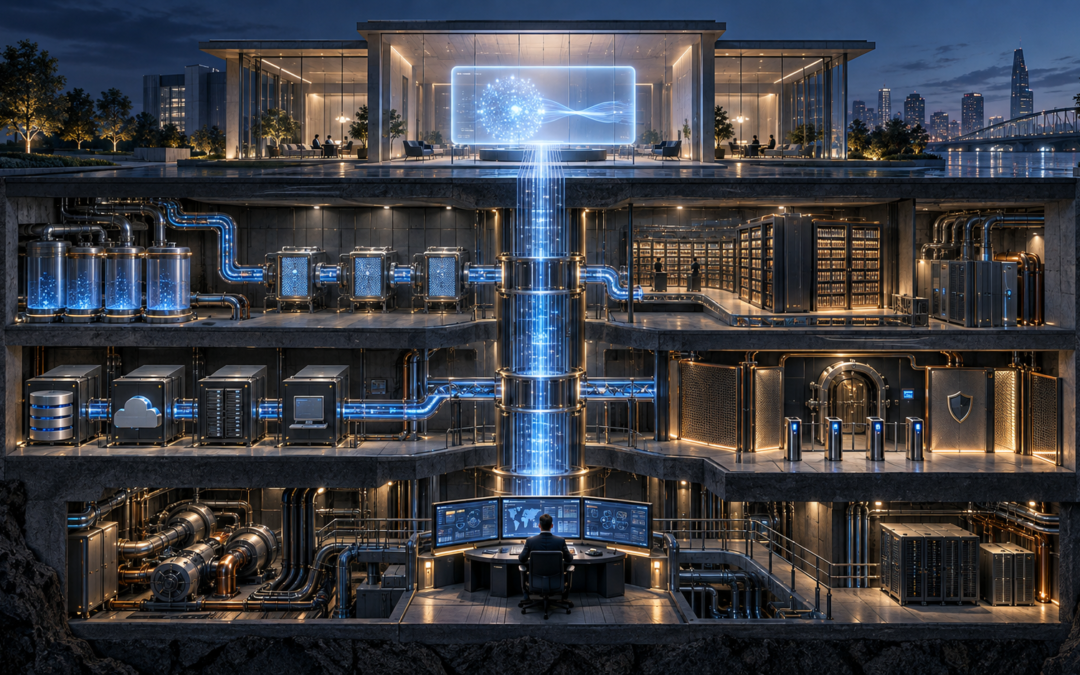
An AI prototype can impress a room with a single answer. A production system has a harder job: it must survive thousands of imperfect requests, incomplete data, partial failures, security constraints and changing business conditions. This is the moment when a promising AI experiment stops being a model demonstration and becomes a systems engineering problem.
The visible answer is only the surface. Beneath it sits an enterprise AI architecture that must control data, isolate failures, observe the quality of outputs, integrate with existing applications and preserve operational control. Every additional layer introduces cost, complexity and another possible point of failure. The objective is not to build the most sophisticated stack, but the smallest reliable architecture that the business case has genuinely earned.
The real question is therefore not whether the model can produce a convincing answer during a controlled demonstration. It is whether the system around it can keep that answer useful, secure and economically viable when real users, real data and real consequences arrive.
Data Pipelines: The Plumbing Behind Reliable AI
A powerful model does not make an AI system reliable. Its answers can only be as current, complete and traceable as the data reaching it.
Think of the data pipeline as the plumbing inside a building. Users see the tap, but the real system is hidden behind the walls. If the pipes leak, the pressure is unstable or the water arrives contaminated, a more expensive tap will not solve the problem. In the same way, a more capable model cannot compensate for incomplete records, conflicting formats or information that has not been updated.
A production data pipeline must extract, validate, transform and deliver information under clear access rules. It must also expose where the data came from and how fresh it is. Not every use case needs real-time processing: sometimes a controlled daily update is safer, simpler and considerably less expensive. The correct architecture follows the speed of the business decision, not the fashion for real-time data.
MLOps and Orchestration: Keeping AI Operational
An AI system can change even when nobody changes its code. Customer behaviour evolves, markets move and the data arriving today may no longer resemble the data used to train the model. Its performance can therefore decline while the application itself continues to run normally. This is what makes AI particularly deceptive in production: a healthy server does not necessarily mean a healthy decision.
MLOps brings industrial discipline to that moving system. Models, data, prompts, configurations and evaluation results must be versioned so that teams know what is running, why it was released and how to return to a safer version. Monitoring can reveal changes in inputs, outputs, latency, cost or business outcomes, but it should not automatically assume that every variation is a failure.
Retraining is therefore not a repair button that should be pressed without supervision. In critical environments, it is a controlled release decision that requires evaluation, approval and the possibility of rollback. Orchestration coordinates the services, processing jobs and computing resources around that decision. It helps the system absorb demand and recover from failures, but it cannot make capacity limits disappear. Queues, timeouts, fallback paths and clear service limits are still part of the architecture. Patterns such as the circuit breaker help prevent a failing dependency from spreading disruption through the entire system.
RAG: Giving AI Context Without Promising Certainty
Language models are designed to produce plausible language, not to verify the truth. When the necessary context is missing, they can generate a confident answer that is unsupported or simply wrong. This is commonly called a hallucination. In a creative exercise, it may be harmless. In a financial report, a compliance process or an operational decision, confidence without evidence is a serious risk.
Retrieval-Augmented Generation, or RAG, gives the model a reference point. Imagine asking someone a question and allowing them to consult an approved library instead of answering entirely from memory. Before generating its response, the system searches selected manuals, records or internal policies and places the most relevant passages in front of the model.
This can make answers more grounded and easier to verify, but it does not create certainty. The system may retrieve the wrong document, rely on outdated information or misunderstand a correct source. Security also depends on where the models and data are hosted, how access is controlled and what information is sent to each component. A responsible RAG architecture therefore measures retrieval quality, respects existing permissions and allows the system to decline or escalate a question when the evidence is insufficient.
Interoperability: AI Is Not an Island
An AI system that cannot exchange information with the rest of the organisation remains an expensive demonstration. Its value appears when it can work with the systems where the business already operates: the ERP, the CRM, document repositories, communication tools and internal applications.
APIs provide the bridges between those systems, but connecting them is only the beginning. An API gateway can provide a controlled entry point, but it should remain a boundary rather than become a bottleneck. Reading a customer record is not the same risk as changing it. Producing a recommendation is not the same as triggering a workflow or sending a message. Each integration needs explicit permissions, validation rules, audit trails and a clear decision about when human approval is required.
A sound architecture therefore treats the model as one component behind a stable boundary, not as a brain wired directly into every application. If a model, provider or business system changes, that boundary absorbs much of the impact. The objective is not to create another intelligent silo, but to weave intelligence into existing operations without surrendering control of them.
Governance and Security: Control Is Part of the Architecture
Technology without control is not an enterprise architecture. Governance defines who may use the system, which information it may access, what actions it may perform and who remains accountable when something goes wrong.
A marketing intern and a CFO should not enter the system with the same keys. Role-based access control is one part of the answer, but not the whole of it. Sensitive data must be classified, access must follow the principle of least privilege and important actions must leave an audit trail. The architecture must also address model-provider retention, data leakage, prompt injection and the points at which human review becomes mandatory. The OWASP Top 10 for LLM and GenAI applications provides a practical reference for these model-specific security risks.
Regulatory obligations cannot be added as a final layer once the system is already built. The applicable jurisdiction, the nature of the data and the organisation’s contractual commitments influence hosting, retention, transfer and auditability from the beginning. Good governance does not prevent an AI system from creating value. It defines the boundaries within which that value can be trusted.
Build an Enterprise AI Architecture in Layers, Not All at Once
A pilot used by twenty employees does not need the same machinery as a regulated service handling thousands of daily requests. Building every possible capability from the beginning does not make the system more mature. It may simply make it more expensive, harder to understand and more difficult to change.
The architecture should grow with evidence. Begin with a narrow workflow, explicit boundaries and measurable criteria for success. Add real-time pipelines, automated scaling, advanced orchestration or additional governance controls when volume, risk or operational experience justifies them. Every component should solve an observed problem rather than prepare for an imagined one.
Scalability is not the ability to predict every future requirement. It is the ability to evolve without rebuilding everything each time the future proves us wrong. Stable interfaces, observable behaviour and reversible decisions create that freedom far more effectively than unnecessary complexity.
Conclusion: Architecture Turns a Model into a System
Moving AI from a demonstration into production is not primarily a model-selection exercise. It is an architectural one. Data pipelines determine what the system knows. MLOps reveals how it behaves over time. RAG can provide relevant context. APIs connect it to the business. Governance defines what it is allowed to do.
None of these components guarantees scalability on its own. Reliability emerges from the boundaries between them, from the failures the system is prepared to absorb and from the decisions that remain reversible. A mature enterprise AI architecture does not pretend that the model will always be right, the data will always be clean or demand will always be predictable. It is designed with those realities in mind.
At Intech Heritage, this is how we approach AI systems: begin with the business constraint, introduce only the layers the use case requires and preserve the ability to evolve as evidence replaces assumptions. The competitive advantage is not simply having more AI. It is being able to operate it without losing control.