
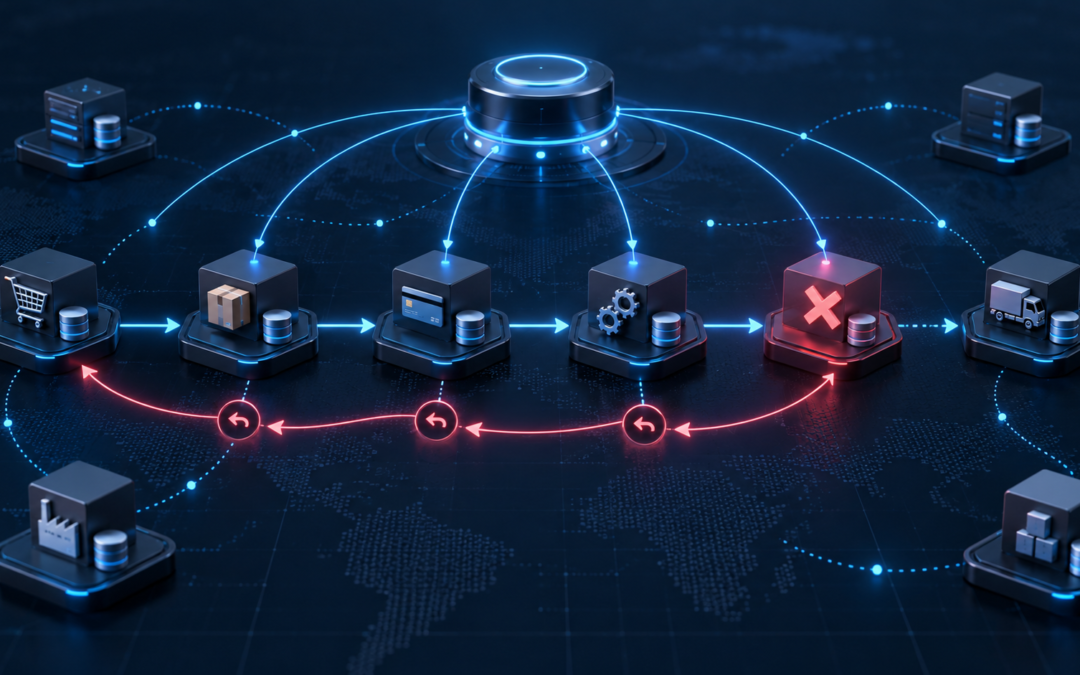
In today’s world of distributed architectures, managing transactions that span multiple microservices is one of the greatest challenges. This is where the Saga pattern in microservices comes into play. It provides a practical way to coordinate local transactions, handle failures through compensating actions, and maintain eventual consistency across the system.
What Is the Saga Pattern in Microservices?
The SAGA pattern is an approach for managing distributed transactions in microservices architectures. Instead of using a single transaction that locks resources across all the services involved, as in the traditional two-phase commit (2PC) approach, the SAGA pattern divides the transaction into a sequence of steps or subtransactions, each with a compensating action in case of failure.
What is Two-Phase Commit (2PC)?
Two-Phase Commit (2PC) is a protocol used to ensure strong consistency in distributed transactions. In 2PC, a transaction involving multiple nodes or services follows two phases:
- Prepare phase: All participants receive a preparation request, and each responds if they can commit the changes or not.
- Commit phase: If all participants are ready, a commit request is sent to confirm the changes. If any participant cannot complete the operation, a rollback is initiated to undo the changes. 2PC ensures strong consistency, but it can block resources for long periods, which is problematic in distributed systems requiring high availability and scalability.
How Does the SAGA Pattern Work?
The SAGA pattern replaces a single distributed transaction with a sequence of local transactions. Each service completes its own transaction and then triggers the next step through an event or command. If a step fails, compensating transactions are executed to reverse the effects of the steps that have already completed.
There are two main approaches for coordinating a Saga:
- Choreography: Each service reacts to events and publishes the event that triggers the next service. There is no central coordinator.
- Orchestration: A central orchestrator directs the participating services, tracks the workflow and initiates compensating actions when necessary.
Choreography is generally suitable for simpler workflows involving fewer services. Orchestration makes complex workflows easier to follow and control, but introduces a central coordination component.
Why Adopt the SAGA Pattern?
The main advantages of the SAGA pattern are:
- Robustness: Improves the system’s ability to recover from failures, allowing for efficient compensations.
- Scalability: Resources don’t need to be locked, allowing for greater scalability in independent microservices.
- Decoupling: Enables services to operate autonomously, facilitating system evolution.
How to Implement the SAGA Pattern?
To implement Sagas:
- Identify the microservices: Define the services that participate in the transaction.
- Define subtransactions and compensations: Ensure each service has a compensating action.
- Orchestration or Choreography: Choose the appropriate approach based on complexity.
- Use frameworks: Tools can facilitate SAGA implementation.
Tools for Implementing the SAGA Pattern
There are many tools that simplify the implementation of Sagas in distributed architectures:
Libraries and Frameworks
- Spring ecosystem
- Spring Cloud Stream: Provides messaging abstractions that can support event-driven Saga choreography, although it does not implement Saga coordination by itself.
- Spring Cloud Stream Kafka Streams binder: Integrates Spring Cloud Stream applications with Kafka Streams for event-driven processing.
Eventuate Tram Sagas: Provides orchestration-based Saga support for Java microservices, built on the transactional messaging capabilities of Eventuate Tram.
- Axon Framework: Known for Event Sourcing and CQRS, it is also ideal for implementing Sagas. Its event-based approach allows for smooth integration in distributed architectures.
- Camunda: A process automation platform that manages workflows with BPMN, ideal for orchestration in Sagas.
- Apache Camel: Offers a Saga component that facilitates the coordination of distributed microservices through messaging.
Cloud Services
- AWS
- AWS Step Functions: Ideal for distributed workflows, allowing the implementation of Sagas via orchestration.
- Amazon SWF: Provides more control over the state of distributed transactions.
- Azure
- Azure Durable Functions: Allows writing stateful workflows in a serverless environment, ideal for Sagas.
- Azure Logic Apps: Provides a visual interface for designing and automating workflows.
- Google Cloud
- Google Cloud Workflows: Allows for orchestrating services and APIs to implement Sagas.
Other Alternatives
- MicroProfile LRA: Manages long-running transactions in microservices.
- Temporal.io: Open-source platform for durable workflows.
- NServiceBus Sagas: Part of the NServiceBus platform, specialized for .NET.
Considerations for Choosing Tools
When selecting a tool to implement Sagas, consider factors such as:
- Technology stack: Choose tools compatible with the technology already in use.
- Complexity: Tools like Axon Framework or Temporal.io are designed for more complex flows.
- Infrastructure: Cloud options like AWS Step Functions offer managed solutions, while tools like Camunda provide more control on local servers.
- Learning curve: Some platforms require more time to master but offer greater flexibility and control.
When Should You Use the SAGA Pattern?
Deciding when to use the SAGA pattern depends on the specific characteristics of the distributed system and the transaction requirements. SAGA is ideal for managing complex distributed transactions and ensuring availability and scalability without locking the resources of the involved microservices. Below are scenarios where the SAGA pattern is the best option and those where other alternatives may be more appropriate.
When to Use the SAGA Pattern
- Long-running distributed transactions: In systems where transactions may span multiple services and must not lock resources for a long period, SAGA is essential. By dividing transactions into independent steps, resource blocking across multiple services is avoided, improving performance and scalability.
- High fault tolerance: In environments where robustness is crucial, the SAGA pattern allows compensating actions in case of failures, ensuring the system quickly recovers without affecting global consistency.
- Decoupled systems: In microservices architectures where services need to operate autonomously, choreography within the SAGA pattern allows services to interact via events, facilitating independent evolution.
- Scalability: For systems requiring high scalability, the SAGA pattern is excellent, as it doesn’t rely on global transactions that block services, allowing each microservice to process its transactions independently.
- Complex business processes: In scenarios where business rules span multiple services and require detailed control over transaction flow, the orchestration approach in SAGA provides a centralized view and facilitates error handling.
When Not to Use the SAGA Pattern
- Single-service transactions: If all changes occur within one service and one database, a local ACID transaction is usually simpler and more appropriate than a Saga.
- Strict immediate consistency requirements: A Saga relies on eventual consistency. If every participant must commit atomically, a distributed transaction protocol such as 2PC may need to be evaluated, provided the infrastructure supports it and its availability and blocking trade-offs are acceptable.
- Operations that cannot be compensated: A Saga requires explicit compensating actions. If completed operations cannot be reversed safely or meaningfully, the pattern may not be suitable.
- Simple workflows with limited benefit: Sagas introduce additional requirements around coordination, retries, idempotency, observability and debugging. That complexity may not be justified for a simple business process.
Conclusion
The Saga pattern helps maintain data consistency across microservices through a sequence of local transactions and compensating actions. It is particularly valuable for workflows that run over long periods, where availability and service autonomy matter more than immediate global consistency.
These benefits come with additional complexity. Teams must design reliable compensating actions, handle retries and idempotency, maintain clear observability and understand the possible intermediate states of the workflow. A simpler transactional approach may be more appropriate when immediate strong consistency is mandatory or when the entire transaction can remain within a single service and database.
Choosing the Saga pattern should therefore be driven by the requirements of the business process and its failure scenarios, not simply by the use of microservices.
For another approach to improving resilience in distributed systems, read our guide to the Circuit Breaker pattern in microservices architectures.